Why a Doorway Can Feel Hard to Find
Learn how to read a building entrance by tracing its approach, placement and contrast, then separate visual clarity from the features that support access.
Why can a doorway feel hard to find even when it is plainly visible? A building entrance can disappear in a long façade, sit beyond an unclear approach or blend into surrounding materials. To judge whether a doorway reads clearly, trace how a visitor arrives and what cues point towards the opening, then assess accessibility separately.
Start where a visitor first looks for the entrance
Begin at the place someone would naturally approach from: the pavement, car park, courtyard or path from a bus stop. Do not start by standing directly in front of the door. From that closer position, the entrance may seem obvious even though its location is unclear from the route.
Look towards the building and note which parts attract attention. A projecting canopy, a recessed bay, a pair of doors or a change in the façade may suggest an entrance. Check whether those cues point to the door people are meant to use, rather than to a window, display or secondary opening.
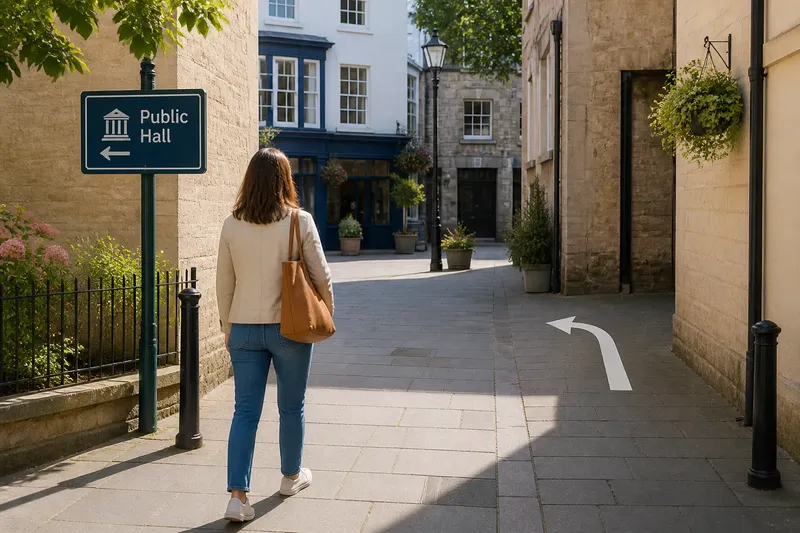
Then follow the likely route with your eyes. Does a path, paving change, handrail or covered walkway lead naturally towards the opening? An entrance can be visible yet feel detached from the approach if the route appears to stop, divide or continue past it.
Trace how the entrance sits within the façade
Placement gives a doorway meaning. A door centred beneath a canopy may read as the main entrance, while a door at the end of a blank wall may look like a service access. Neither arrangement is inherently clear or unclear; the surrounding composition tells visitors how to interpret it.
Notice whether the entrance is set back, tucked around a corner or placed between repeated bays. Recesses can make a doorway harder to see from an oblique angle. Repetition can also make one bay resemble another, especially if the actual entrance has no distinct frame, canopy or route leading to it.
Consider the approach angle. A door may be easy to spot from straight ahead but hidden by a wall return when someone arrives from the side. If people have to pass the opening before they can see it, the building may need a cue visible earlier along that route, such as a projecting canopy or a sign positioned where it can be seen without turning back.
Check whether contrast identifies the door itself
Contrast is a difference that helps one element stand out from its surroundings. It can come from colour, brightness, texture, depth or the edge created by a frame. For an entrance, the useful question is not simply whether the door is a different colour, but whether a visitor can distinguish the opening and its boundaries against the wall.
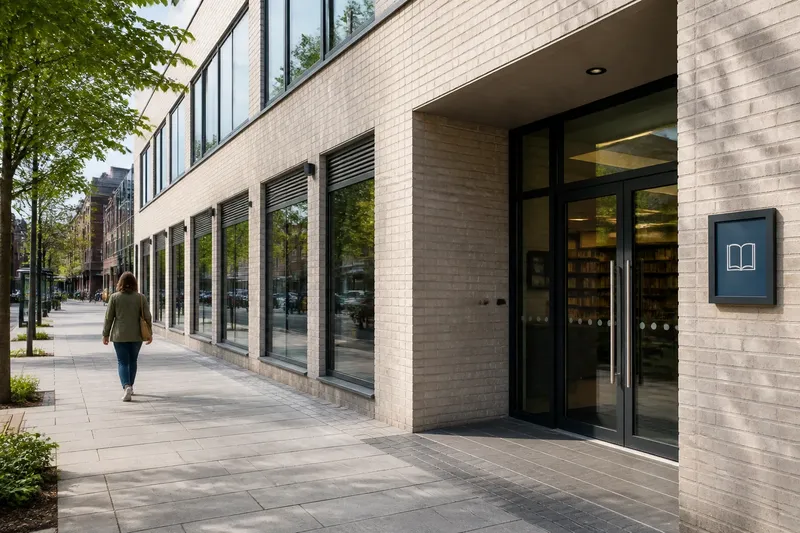
A dark door in a dark recess may merge into shadow. A glass door may reflect the street and appear to be a window. A door finished like the surrounding cladding may look visually continuous with the façade. Examine these conditions from the visitor’s approach, not only from a close view in good light.
Look for cues that remain legible when one feature is less apparent. If a painted door is difficult to distinguish under shade, a clear frame or canopy may still mark the entrance. If glazing creates reflections, a visible handle, door edge or entrance sign can help clarify that the surface opens.
Say you are assessing an invented neighbourhood library with a recessed glass door behind a row of similar windows. From the pavement, the doorway looks like another pane; a small sign is visible only after someone reaches the recess. If the library marks the entrance with a projecting canopy and places a sign where the approach begins, visitors could identify the route earlier, while the door itself remains glazed.
Follow the route without confusing clarity with access
Once you have found the entrance, assess the approach as a separate question. Visibility describes whether people can identify the door. Accessibility concerns whether people can reach, enter and use it. A clear visual cue does not establish that the route or doorway works for someone using a wheelchair, mobility aid, pram or cane.
Observe whether the route appears continuous and unobstructed, and whether the entrance can be approached without an abrupt change in level or a narrow detour. Notice steps, steep-looking ramps, heavy doors, tight turns and objects that might narrow the path. These are prompts to seek an accessibility assessment, not a basis for declaring a building accessible or inaccessible by sight alone.
Also separate the entrance that looks prominent from the one intended for public use. A dramatic front door may be locked, while the usable entrance is around the side. If that is the arrangement, signs and route cues need to guide visitors before they reach the unusable door, rather than leaving them to search the façade.
Make a clear assessment in a consistent order
For a useful observation, record the same cues in sequence. This keeps a strong colour or attractive canopy from dominating your judgement about the whole arrival experience.
- Starting viewpoint: If the entrance is not identifiable from the pavement, car park, courtyard or path where visitors first arrive, then record that point as the first wayfinding problem; if it is visible, move on to tracing the route.
- Approach line: If the path appears to stop, divide or pass the entrance, then note where it becomes unclear and consider a route cue; if it leads clearly to the door, check the façade position next.
- Façade position: If the door is recessed, around a corner or one of several similar openings, then look for a frame, canopy or sign that distinguishes it; if its placement already reads clearly, assess the view from the side.
- Visual cues: If no contrast, frame, canopy, lighting, handle or sign identifies the actual opening, then consider clearer wayfinding or a more distinct cue; if at least one cue is legible, check whether it remains so in shade or reflection.
- Angle and conditions: If the door disappears from a side approach or in changing light, then record the affected viewpoint and consider a cue visible from there; if it remains recognisable, move on to access questions.
- Access questions: If steps, obstacles, level changes, tight turns or door-use concerns are visible, then seek a qualified accessibility review; if none are apparent, do not treat that observation as proof of accessibility.
- Next action: If confusion begins before the entrance comes into view, then consider earlier wayfinding; if the door itself blends into the façade, consider a clearer entrance cue; if the concern involves route or door use, seek specialist access advice.
When an observation suggests that a physical alteration may be needed, do not infer a safe design from appearance alone. Building requirements, manufacturer instructions and local rules can affect what changes are appropriate; consult a qualified building or access professional where those decisions matter.
How should you judge an entrance when the light changes?
Does a doorway have to be a different colour from the wall?
No. A strong colour difference can help, but a frame, recess, canopy or clearly placed sign may also mark the opening. Judge whether the door can be distinguished in its actual setting rather than treating colour as the only useful cue.
Can a glass entrance still read clearly?
Yes, if visitors can recognise both that it is an entrance and where the door opens. Reflections may make glazing resemble a window, so look for a visible edge, handle, sign or framing that clarifies its purpose from the approach.
Is a prominent entrance necessarily accessible?
No. Visual prominence says nothing on its own about the route, level changes, door operation or space to manoeuvre. Keep those observations separate and seek a qualified assessment when access decisions are needed.
What if the public entrance is round the side?
Check whether signs or architectural cues direct visitors towards it before they reach the front door. A side entrance can be easy to find if the route is made legible from the arrival point, though its accessibility still requires a separate assessment.
Use the point of confusion to choose the next question
A useful doorway assessment ends with a specific observation, not a general verdict. “The entrance is hard to find” gives little direction; “the path reaches a row of identical windows before the side door comes into view” identifies where the cue fails and what should be examined next.
For a building entrance that remains difficult to locate, revisit the earliest point of uncertainty: the first view, the turn towards the building, the façade or the door itself. That small distinction helps an owner or designer consider the right response, while keeping the separate question of access in view.