Before the Shop Window: How Local Shopfronts Changed Over Time
Local shopfront history traces the shift from open counters to glazed displays, helping you date visible changes and understand how shops meet the street.
When did a shop begin showing its goods through glass rather than across an open counter? Local shopfront history follows that change from medieval street trade to the familiar glazed frontage, while also explaining why older features often survive beside newer ones.
Street trade began at an open threshold
In medieval towns, many retailers worked from narrow buildings facing busy streets. An opening at ground level could serve as both entrance and sales counter: shutters folded back or lifted to expose goods, and customers could buy without walking far inside. The boundary between pavement and business was active, not a fixed sheet of glass.
Timber shutters had practical roles. Closed at the end of trading, they protected the opening; opened during the day, they could help form a ledge or counter. A shopkeeper’s presence, the arrangement of goods and the condition of the opening all signalled whether trade was under way.
These arrangements varied by place and trade. A stall attached to a building, a workshop opening and a market-facing shop did not share one standard design. The useful historical point is that display and access were often combined at the opening itself.
Glass made display visible without opening the shop
In the early modern period, glassmaking improved and larger panes gradually became more practical for shop use. The change was uneven: cost, supply and local building traditions affected how quickly a glazed window appeared. Small panes held in leaded frames were common before larger, clearer sheets became easier to obtain.
By the eighteenth century, shop windows had become a more recognisable feature in many British towns. A glazed opening let a shopkeeper display goods while keeping the interior closed to weather and street traffic. Customers could look first and decide whether to enter, so the window took on a role once handled by the open counter.
Glass did not make every shop transparent. Mullions, curtains, lettering, shutters and the depth of the window reveal still shaped the view. A bright display might draw attention, while a narrow doorway or heavy door could keep the threshold formal and controlled.
The nineteenth century enlarged the shopfront
During the nineteenth century, advances in glass production and the growth of urban commerce encouraged larger shop windows. Plate glass could provide broad, relatively uninterrupted views, and iron or slender timber supports helped create wider openings. In expanding commercial streets, shopfronts increasingly competed for the attention of people passing on foot or by carriage.
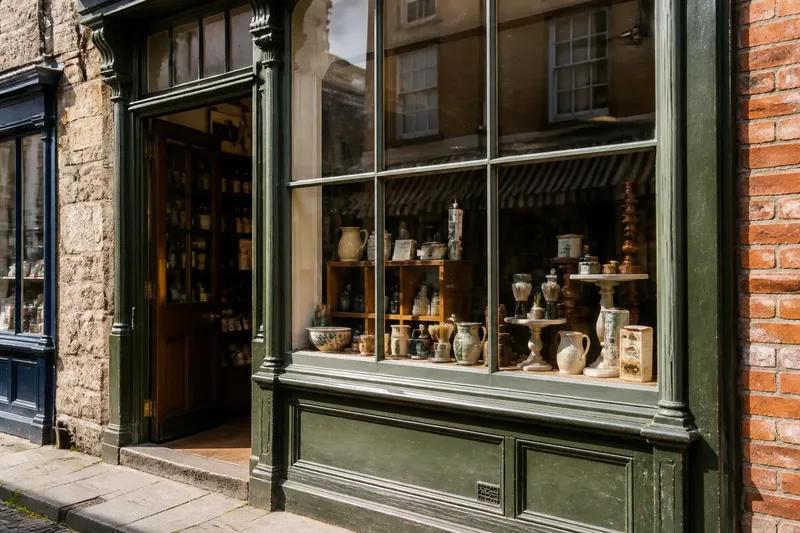
At the same time, the street-facing frontage became a more composed part of the building. A fascia carried the shop name above the window; pilasters or columns framed the display; a stallriser formed a solid panel below the glass. The entrance might sit centrally or to one side, depending on the building and the way the business used its floor space.
These changes did not happen everywhere at once. A small-town shop could retain an older timber frame while replacing only its glazing, and a historic opening might be adapted several times. A frontage seen today can therefore combine elements from different periods rather than preserve one complete original design.
Electric light and changing retail habits altered the display
From the late nineteenth century into the twentieth, electric lighting made it easier for shops to keep displays visible after daylight faded. Shopkeepers could arrange goods for people looking from the pavement, using shelves, stands and backdrops to make particular objects stand out. The display became a deliberate public message as well as a practical way to show stock.
Twentieth-century changes brought further variety. Some businesses adopted broad plate-glass windows and open interiors; others used blinds, lettering or opaque panels to control views. Aluminium and other manufactured materials became more common in later refits, while traditional timber, stone and brick remained visible in many older streets.
New materials did not erase the earlier shopfront. A later window might sit inside an older masonry opening, or a modern sign might cover a former fascia. The joins between materials can reveal adaptation, though appearance alone rarely establishes an exact date.
How can you read the age and use of a shopfront?
What is a stallriser?
A stallriser is the solid panel beneath a shop window, often made from timber, stone or brick. Its height and material can help distinguish the display area from the pavement, but it may have been altered during a later refit.
Why are older shopfronts made from several materials?
Shopfronts were repaired and remodelled as businesses and materials changed. If glazing, sign panels and masonry meet at different alignments, treat those joins as clues to successive alterations rather than proof of a precise date.
Does a large window mean the whole frontage is modern?
No: replacement glass can occupy an older opening, while a later frame may preserve the original doorway position. Compare the window with the surrounding wall, lintel, sill and entrance before judging which parts may belong to different phases.
How can I check a shopfront’s history?
Begin with visible clues, then compare them with old photographs, local maps, planning records or a local history collection. For a listed building or a proposed alteration, consult the local planning authority or a conservation professional before drawing conclusions or making changes.
Use a few visible clues to choose what to investigate
A quick inspection can help you separate what is directly observable from what still needs checking. For each feature, record what you see and let the result guide the next question.
- Window frame: If the frame sits neatly inside an older stone or brick opening, compare the opening with historic photographs; if the surround also looks recently rebuilt, look for other records before assigning a period.
- Glass: If the panes are small and divided by lead or narrow bars, compare them with nearby older frontages; if a broad sheet fills the opening, check whether the frame or wall around it appears older.
- Stallriser: If a solid panel remains below the glass, note its material and whether it aligns with the doorway; if it is missing or replaced, use photographs or maps to check for an earlier base.
- Fascia: If a sign panel covers the upper frontage, look for surviving edges or brackets; if the wall continues uninterrupted above it, check archival images before assuming a former fascia was present.
- Entrance: If the doorway is recessed, note how the reveal meets the building wall; if it is flush or moved to one side, compare its position with the structure and any older street images.
- Shutters or blinds: If they remain, note where they sit when open and closed; if none are visible, do not infer that the shop never had them—look for fixing points or documentary evidence.
Say you are examining an invented high-street grocer with a wide modern-looking window, a stone surround and a doorway set into a shallow recess. First, you record those three visible features without dating them. Next, you compare the frontage with an old street photograph held by the local library; in this invented situation, the photograph shows the same stone opening and doorway but smaller divided panes. You then conclude that the opening and entrance pre-date the current glazing, while the precise installation date of the wide window remains uncertain. The practical result is a clear distinction between what the evidence supports and what still needs a record.
Shopfront history remains visible in the street
Local shopfront history is not a straight progression from open shutters to glass. The change unfolded unevenly: early trade often brought goods to the opening, eighteenth-century glazing made display possible behind a boundary, and nineteenth-century plate glass expanded the scale and prominence of the window. Later lighting and materials changed how shops presented themselves without removing every earlier frame or opening.
When you pass a shop, look for the relationship between the window, fascia, stallriser and entrance. If one element seems out of step with the others, that difference is a useful lead: compare it with a local photograph or planning record before treating it as a dated fact.