The Bench Must Face the View Myth
Bench orientation shapes whether people watch, meet or rest. Learn how to assess views, foot traffic, company and shelter to choose a useful direction.
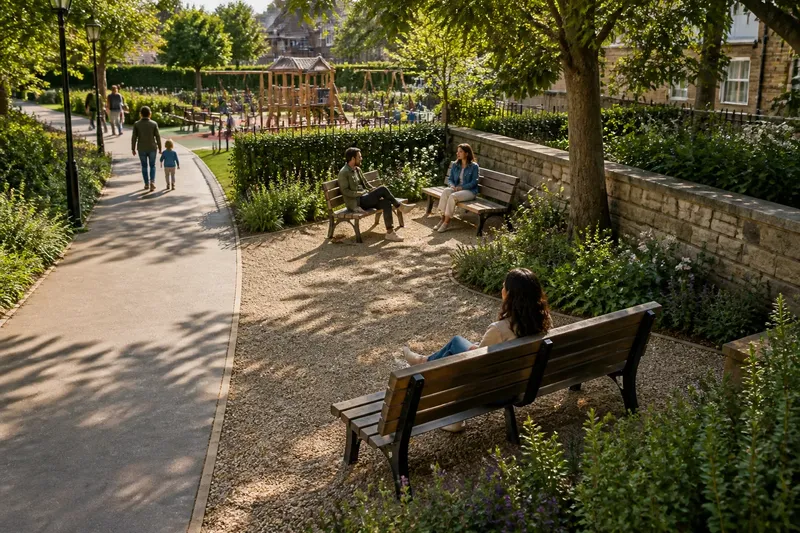
Where should a public bench face? Bench orientation is not simply a choice between a view and a path; it shapes whether people can watch, talk, rest or feel at ease. A bench can overlook a river and still feel exposed, interrupt a route or leave companions looking past one another.
Orientation includes what sits in front of a person, what is visible at the side, who approaches from behind and how the bench relates to paths, trees, walls and other seats. Start with those relationships rather than the most picturesque feature.
A view is only one kind of invitation
A bench facing a view invites people to look outward. That can suit a spot beside water, a garden, a playing field or a lively street. The scene gives someone sitting alone something to attend to without requiring conversation.
But an attractive view is not automatically a comfortable seat-front. Low sun may cause glare, a hedge may hide the scene from seated height, or a nearby path may leave people feeling watched. Check what a seated person can actually see, and consider how the view changes with light and activity.
Ask what the direction invites someone to do: watch, talk, wait, rest or keep an eye on a companion. The answer may differ across one space, so a single bench need not serve every purpose.
Facing a path changes the social distance
A bench facing a path brings passers-by into the scene. In a busy square, that can help someone feel connected to everyday activity. In a quiet garden, the same arrangement may feel exposing.
Consider the space between the seat and the walking line. A planted edge, a low wall, a tree or a change in paving can distinguish a sitting area without blocking the view. Also check how people approach: a bench with its back to a busy route may feel uncomfortable to someone who cannot see others coming.
Turning a bench slightly towards the path can improve awareness while preserving an outward view. This diagonal arrangement may feel different from pointing the seat squarely at either the route or the scenery.
Meeting requires more than placing seats together
People sitting together need to see and hear one another without twisting awkwardly. Benches aligned side by side direct everyone in much the same direction. That can work for watching an event, but it may not encourage conversation.
Seats at an angle make conversation easier while leaving room to look outward. Facing one another supports direct conversation, though it may feel too intense for people who want to talk intermittently. A loose L-shape offers a middle ground: people can turn towards one another or look into the space.
Spacing matters too. Seats set far apart can make conversation awkward; seats crowded together can leave strangers feeling pressed. Choose a relationship suited to the place and its likely uses, such as a quiet corner near a community centre or a seating edge beside a market.
Rest depends on comfort and control
Someone resting may want a view, but may also value shelter, privacy or a clear route back into the space. A bench beside a wall or under a tree can feel settled. If it is too enclosed, however, it may be difficult to see what is happening or to approach and leave comfortably.
Consider sun, wind, rain and shade from trees or nearby buildings. A view that feels pleasant at one time may become uncomfortable when the sun is directly ahead. A sheltered seat with a modest outlook may be more comfortable. Nearby litter bins, service doors or noisy equipment can also undermine a restful position.
Some people want to sit near others without being drawn into conversation. An outward-facing bench with another seat within sight can offer company at a distance. Not every seat needs to turn a public space into a group gathering.
How should bench orientation respond to the place?
Should every bench face the main view?
No. A main view is only one consideration alongside comfort, shade, privacy and movement. If the outlook causes glare or leaves people exposed, an angled or sheltered position may be more suitable.
Is it better for benches to face one another?
Facing seats can help companions talk, but may feel too direct for someone who wants to sit quietly. A slight angle often leaves room to converse and to look around.
How can a bench suit conversation and watching?
Where space allows, use more than one orientation. A view-facing seat and a nearby angled seat offer different choices rather than asking one bench to serve every purpose.
What should be checked before a bench is moved?
Check the seated view, walking routes, shade, approach paths and relationship to other seats. For installation or relocation, follow local requirements and the manufacturer’s instructions for the bench and its fixing.
A site check turns observations into a seating choice
Walk the site from its entrances, shaded edges, busy areas and quieter corners. At each possible seat position, consider what a seated person can see, where people approach from and whether someone can leave without crossing another group. Use the observations to decide what role each bench should serve.
- If the main view is clear from seated height and the seat is comfortable in the available shade, then face it towards the view; if glare or exposure is a problem, angle the bench towards shelter.
- If a path runs close in front of the seat and people would feel on display, then set the bench back or add a planted edge; if the path is part of the desired activity, keep it visible from a more sheltered position.
- If people approach mainly from behind, then turn the seat enough to make arrivals visible; if doing so blocks the main view, consider a diagonal rather than a direct turn.
- If companions cannot see one another without twisting, then angle the seats or make an L-shape; if the purpose is watching an event, keep them aligned towards the activity.
- If a seat has no nearby alternative for quiet rest, then reserve a sheltered position away from the busiest route; if the site is intended for social watching, place a separate seat closer to activity.
- If the proposed position narrows a walking route or makes the entrance awkward, then choose another location; if movement remains clear, retain the position and check how it relates to nearby seats.
Say a small neighbourhood garden has a path along one edge, a children’s play area beyond it and a shaded corner near a low wall. The following are invented observations for this example, not measured facts: the path is busiest beside the play area, the low wall blocks the view from a seat placed directly against it, and a position between the path and wall leaves the route clear. The decision is to angle one bench towards the play area so a seated adult can watch it while noticing people on the path, and to place a second bench near the shaded corner, turned slightly away from the route. The expected observable result is a choice between watching activity and sitting more quietly; the trade-off is that neither bench is aimed squarely at the garden’s most open view.
Bench orientation should follow the use of the space
There is no universally correct direction for a public bench. The useful question is what kind of pause it makes possible. A place for watching may face a garden or activity; a place for meeting may use angled seats; a place for quiet rest may turn away from the busiest route and towards shelter.
Bench orientation works best when the site offers choices without obstructing movement or making one seat compete with another. Look beyond the postcard view: check what a seated person can see, how others approach and whether the seat makes it comfortable to join in or stay apart.